






- Hide-a-bed
- Mattresses
- Bed Bases
- Headboards
- Bedding
- Pillows
- Fabrics
- Lighting
- Hot Sleepers
The New Zealand Mattress Buying Guide
Buying a new mattress is one of the more significant purchases you'll make for your home — and one of the more confusing ones. Firmness ratings, coil counts, latex certifications, memory foam densities — the terminology can make an already personal decision feel overwhelming. This guide cuts through the noise and focuses on the questions that actually matter for New Zealand buyers.
Start with your sleep position
Your sleep position is the single most useful starting point when choosing a mattress, because it determines where your body needs support and where it needs give.
Side sleepers spend the night with their shoulder and hip taking the most pressure. A mattress that's too firm won't allow these points to sink in, causing the spine to curve upward rather than stay neutral. Side sleepers generally do best on a plush or medium feel — enough give to cushion the pressure points without so much softness that the body sinks in unevenly.
Back sleepers need support across the lumbar region, which naturally curves away from a flat surface. A mattress that's too soft will let the lower back sink too deeply, creating tension through the night. Most back sleepers are comfortable on a medium to firm feel that holds the spine in its natural position.
Stomach sleepers put the most strain on the neck and lower back of any sleep position — the hips tend to drop, arching the spine upward. A firm mattress helps keep the hips level. If you sleep on your stomach, err on the firmer side of the range.
Combination sleepers, those who move through positions through the night, generally do well on a medium feel that balances enough give for side sleeping with enough support for back sleeping.
Understand the materials
Once you know the firmness you need, the material affects feel, temperature and longevity.
Pocket springs respond independently to pressure, which means they contour to the body more precisely than older open-coil systems and reduce motion transfer between sleep partners. Mazon's Smart-Coil range uses a Durapedic coil system — 1.8mm gauge springs with firmer outer springs for edge support. Higher coil gauges, thicker wire, are firmer; lower gauges are softer.
Latex is naturally resilient, breathes well and is resistant to dust mites. GOTS-certified organic latex, used in the Mazon Woola and Hybrid ranges, is produced without synthetic chemicals. Latex mattresses tend to feel responsive rather than enveloping — they push back against body weight rather than conforming around it.
Hybrid mattresses combine a pocket spring support core with a latex or foam comfort layer. They offer the contouring of a spring system with added pressure relief at the surface.
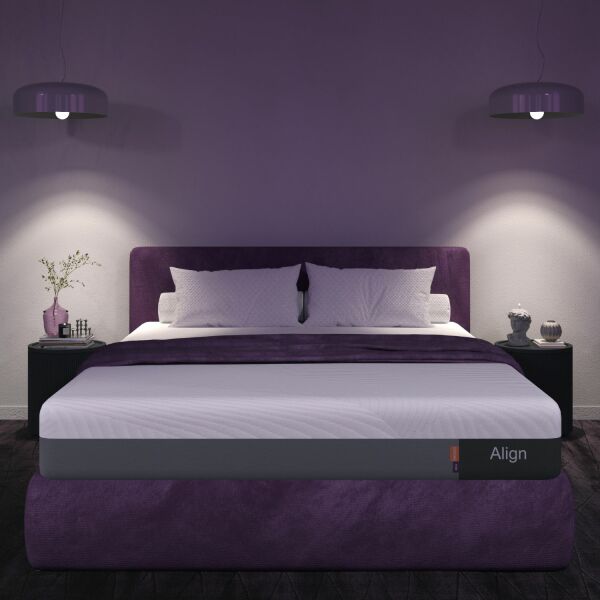
Foam mattresses, such as the Mazon Align range, compress in response to body heat and weight, conforming closely to the body's shape. They're a good option for those who want a quieter mattress with no spring movement. The Align comes boxed and takes up to 72 hours to fully expand after unpacking.
Wool, used in the Mazon Woola range, is a natural temperature regulator — it wicks moisture and keeps you warmer in winter and cooler in summer than synthetic alternatives. The Woola W2000 uses OEKO-TEX certified wool and GOTS latex.
Think about your partner
If you share a bed, a few things become more important. Motion transfer — the degree to which movement on one side of the bed is felt on the other — matters more if one partner is a lighter sleeper or gets up at different times. Pocket spring systems generally transfer less motion than open-coil designs. Edge support matters if both partners sleep close to the edges of the bed; look for mattresses with firmer outer springs or reinforced edges.
NZ-made vs imported
Mazon mattresses are manufactured in New Zealand. This matters for a few practical reasons: warranty claims are handled locally, replacement parts and service are accessible, and the supply chain is shorter — so lead times and quality control are more predictable. When comparing mattresses, it's worth asking where the mattress is made and what the warranty service process actually looks like.
What size do you need?
New Zealand standard mattress sizes:
- Single: 91 x 188cm
- King single: 107 x 203cm
- Double: 138 x 188cm
- Queen: 153 x 203cm
- King: 167 x 203cm
If you share a bed, a queen is the minimum most couples find comfortable. A king gives noticeably more space if room size allows. King singles are popular for teenagers and taller single sleepers. If you need extra support, comfort positioning or easier movement in and out of bed, an adjustable base may also be worth considering.
Don't forget the protector
Fit a mattress protector from the first night. Most mattress warranties require protection against liquid damage, and a protector is the simplest way to satisfy that condition. Mazon's PU Mattress Protector is machine washable and has a 50cm drop to fit mattresses of varying depths.
The Mazon mattress range is available in-store and online. If you'd like help choosing, our in-store team can guide you through the options with a trial before you buy.